Tensor Fusion
Tensor Fusion is a state-of-the-art GPU virtualization and pooling solution designed to optimize GPU cluster utilization to its fullest potential.
Tensor Fusion is an open-source local AI project on GitHub under the Apache-2.0 license (permissive), with 171 stars. It is built with Go, GCC, Gin and GORM. Its last push was yesterday.
- Stars
- 171
- License
- Apache-2.0
- Activity
- Active
- Latest release
- v2.18.6
Judgement
- What it is
- Building block
- What it does
- GPU virtualization for Kubernetes clusters: splits GPUs into fractional virtual GPUs, shares GPUs remotely over the network, and schedules and autoscales GPU workloads.
- Adopt it when
- You run a Kubernetes GPU cluster where cards sit underused and you want to pack more AI workloads onto fewer GPUs.
- Watch out
- It has few public users for infrastructure this deep, and some setup paths go through the vendor's cloud console, so check what the open repo covers on its own.
- Ready for
- Usable
- Runs as
- Self-hosted server
- Built with
- Go, C and Kubernetes
- How established
- Established: started 2 years ago, latest release v2.18.6.
- What the license allows
- You can build it into a product you sell, as long as you keep its copyright notice.
Judged on 2026-11-06 from the project's README and GitHub data. The license and age lines are worked out directly.
Built from
Open-source alternatives to Tensor Fusion
-
1
Ollama ollama
Get up and running with Kimi, GLM, MiniMax, DeepSeek, gpt-oss, Qwen, Gemma and other models.
Developer tool Production-ready You want to run local LLMs for development, privacy or offline use with minimal setup.
★ 186k MIT Go Active, pushed today
-
2
Llama.cpp ggml-org
LLM inference in C/C++
Building block Production-ready You need efficient local or edge LLM inference and want the engine many other tools are built on.
★ 133k MIT C++ Active, pushed today
-
3
Whisper openai
Robust Speech Recognition via Large-Scale Weak Supervision
Building block Production-ready You need accurate offline transcription and want the reference implementation of the models.
★ 112k MIT Python Active, pushed 2 months ago -
4
vLLM vllm-project
A high-throughput and memory-efficient inference and serving engine for LLMs
Building block Production-ready You serve open-weight models to many users on your own GPUs and need throughput.
★ 96k Apache-2.0 Python Active, pushed today
-
5
AnythingLLM Mintplex-Labs
Stop renting your intelligence. Own it with AnythingLLM. Everything you need for a powerful local-first agent experience
Complete system Usable You want private document chat for a small team without building a RAG stack yourself.
★ 68k MIT JavaScript Active, pushed yesterday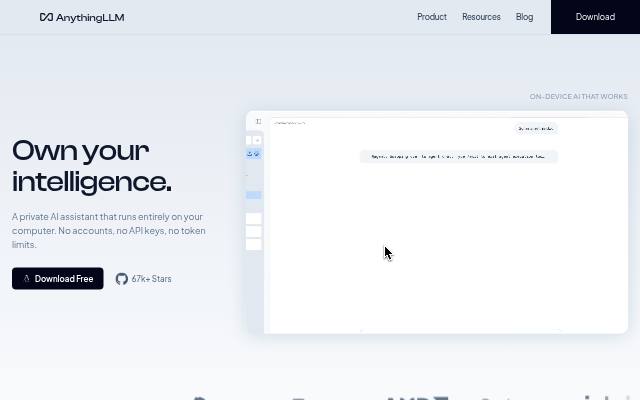
-
6
whisper.cpp ggml-org
Port of OpenAI's Whisper model in C/C++
Building block Production-ready You need transcription embedded in a native, mobile or edge application without Python.
★ 55k MIT C++ Active, pushed 6 days ago -
7
LocalAI mudler
LocalAI is the open-source AI engine. Run any model - LLMs, vision, voice, image, video - on any hardware. No GPU required.
Complete system Usable You want a drop-in local replacement for OpenAI's API covering more than just text.
★ 50k MIT Go Active, pushed today -
8
faster-whisper SYSTRAN
Faster Whisper transcription with CTranslate2
Building block Production-ready You run Whisper transcription in Python at volume and want lower cost and latency without changing models.
★ 26k MIT Python Active, pushed 3 days ago
Commercial tools for running AI models locally
-
1
LM Studio Element Labs
Bionic is LM Studio's agent for work and code. Create documents, slides, PDFs, and software with local or frontier open models.
Complete system Usable You want to run open models privately on your own machine without command-line setup.
Commercial
Stars, license and activity come from GitHub and refresh on a rolling hourly schedule. The project's own description is quoted as written.